
What Is Remote Online Notarization (RON) and Why Is It Transforming Document Signing?


Getting a document notarized used to mean scheduling an appointment, traveling to an office, waiting in line, and hoping you remembered to bring a valid ID. For millions of Americans, that process was not just inconvenient, it was a barrier. Today, that friction is disappearing fast, thanks to remote online notarization (RON).
From real estate closings to estate planning and healthcare documents, RON is rapidly becoming the standard for secure, legal document verification. And with over 45 states now authorizing it, the momentum is only growing.
This guide covers everything you need to know about the rise of remote online notarization: what it is, how it works, which states allow it, and why businesses across every industry are making the switch.
What Is Remote Online Notarization (RON)?
Remote online notarization (RON) is the process of notarizing a document entirely online, using secure audio-visual technology, electronic signatures, and multi-factor identity verification. Both the signer and the notary public participate from separate locations, connected through a secure video platform.
Unlike traditional notarization, where both parties must be physically present, RON allows documents to be signed and notarized from anywhere in the world, as long as both parties have internet access and the notarization is permitted under applicable state law.
RON is built on four core components:
Identity Verification - Multi-step processes such as knowledge-based authentication (KBA) and credential analysis confirm the signer's identity before the session begins.
Live Audio-Visual Technology - Both parties communicate in real time via webcam, simulating an in-person meeting with a documented digital record.
Electronic Signatures and Notary Seals - Documents are signed and sealed digitally using tamper-evident technology.
Secure Audit Trail - Every session is recorded and stored according to state requirements, providing a verifiable digital record for compliance and dispute resolution.
How RON Differs from Traditional and Mobile Notarization
It helps to understand where RON fits in the broader notarization landscape:
Traditional notarization requires the signer and notary to be physically present in the same location. The notary manually reviews a government-issued photo ID and applies a physical seal to the document. This method is still widely used but comes with obvious logistical limitations.
Mobile notarization allows a commissioned notary to travel to the signer's location: a home, office, or hospital. It adds convenience compared to traditional notarization, but it is still an in-person process subject to travel time and scheduling constraints.
Remote online notarization (RON) removes location entirely from the equation. It is a fully digital process conducted over the internet, combining the legal validity of traditional notarization with the speed and flexibility of modern technology.
A Brief History: How RON Went from Niche to Nationwide
Remote online notarization is not brand new. Virginia became the first state to pass RON legislation back in 2011, though widespread adoption was slow for nearly a decade. Early adopters were mostly title companies and mortgage lenders in states where the law was on the books, but most of the country was not yet ready for the shift.
By 2019, a handful of states including Texas, Montana, Nevada, and Michigan had passed RON laws. The landscape was fragmented, platforms were limited, and many industries continued to rely on in-person processes out of habit or hesitation.
Then came 2020, and everything changed.
The COVID-19 Turning Point
The COVID-19 pandemic forced the world to rethink every process that required physical presence. Courts, businesses, and government agencies scrambled to enable document signing and notarization without requiring people to gather in person.
The impact was dramatic. According to data cited by Blend, RON adoption surged by 547% in 2020, as businesses and individuals turned to digital solutions out of necessity. States fast-tracked emergency RON legislation. Platforms that had been operating on the fringe suddenly found themselves at the center of a transforming industry.
What began as a crisis response quickly became a permanent shift. Many states that adopted RON under emergency orders later passed permanent legislation, recognizing the efficiency gains and borrower satisfaction that came with it.
The SECURE Notarization Act and Federal Progress
Legislative momentum has continued beyond the pandemic. In July 2022, the U.S. House of Representatives passed the SECURE Notarization Act (Securing and Enabling Commerce Using Remote and Electronic Notarization Act), a bipartisan bill that would establish federal minimum standards for RON and require all states to recognize out-of-state RON transactions.
The bill stalled in the Senate at the time, but the effort did not stop. In May 2025, the SECURE Notarization Act of 2025 (S.1561) was introduced in the 119th Congress, continuing the push toward a unified national framework for electronic and remote notarizations.
As of early 2025, 45 states plus the District of Columbia have authorized remote online notarization, with approximately 90% of the United States having permanently adopted RON legislation. The remaining holdouts are expected to follow as federal standards solidify.
How Remote Online Notarization Works
The RON process is designed to be simple for signers while maintaining robust legal and security standards. Here is how a typical RON session unfolds from start to finish.
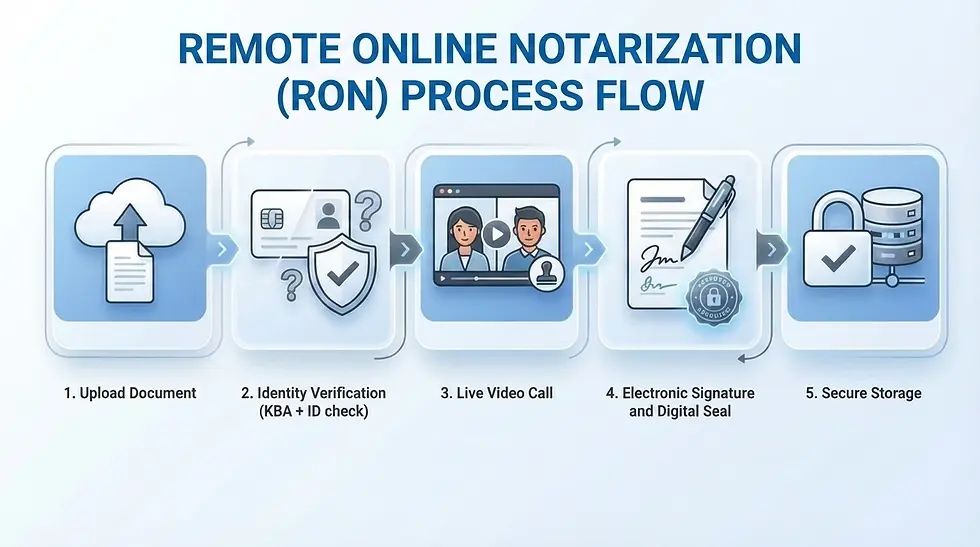
Step 1: Upload Your Document
The signer uploads the document to be notarized to a RON platform. This may be a real estate closing document, a power of attorney, a healthcare directive, a loan agreement, or any other document requiring notarization.
Step 2: Identity Verification

Before the live session begins, the signer goes through a multi-step identity verification process. This typically includes:
Knowledge-Based Authentication (KBA): The signer answers a series of personal, credit-history-based questions that only the true document holder would realistically know.
Credential Analysis: The signer uploads a photo of their government-issued ID (driver's license or passport), and advanced software verifies its authenticity.
This two-layer approach is significantly more robust than a notary simply looking at an ID card across a desk.
Step 3: Live Audio-Visual Session
Once identity is verified, the signer connects with a commissioned online notary via a secure video call. The notary confirms the signer's identity, ensures they understand what they are signing, and checks that they are signing willingly and without duress, the same standards that apply in traditional notarizations.
Step 4: Electronic Signature and Notary Seal
The signer applies their electronic signature to the document within the platform. The notary then applies their electronic notary seal and digital certificate, creating a tamper-evident, legally binding notarized document.
Step 5: Secure Storage and Audit Trail
The completed session, including the video recording, identity verification data, and signed document, is securely stored in accordance with state requirements. This audit trail is accessible for compliance, legal review, or dispute resolution.
The entire process typically takes 15 to 30 minutes and can be completed from any device with a camera and internet connection.
Key Benefits of Remote Online Notarization
RON offers compelling advantages for individuals, businesses, and notaries alike. Here is why adoption continues to accelerate.
Convenience and Flexibility
Signers can complete notarizations from their home, office, or even while traveling. There is no need to locate a local notary, schedule a meeting, or arrange transportation. International clients and out-of-state signers can participate just as easily as anyone down the street.
Speed and Efficiency
RON eliminates the delays caused by travel, scheduling conflicts, shipping paperwork, or last-minute cancellations. Documents can be executed and delivered the same day they need to be signed. For time-sensitive transactions like real estate closings or legal filings, this is a significant competitive advantage.
Enhanced Security and Fraud Prevention
Traditional notarization relies heavily on a notary visually inspecting an ID, which is an imperfect process. RON adds multiple layers of fraud prevention through KBA, credential analysis, and video recording. Every step is documented and stored, creating a much more defensible and verifiable record.
Cost Savings
For businesses that process large volumes of notarized documents such as title companies, law firms, financial institutions, and HR departments, RON reduces the cost associated with traveling notaries, courier services, overnight shipping, and document management.
Environmental Sustainability
The mortgage industry alone requires tens or even hundreds of printed pages per transaction. With fully digital RON workflows, organizations can significantly reduce paper consumption. At scale, across millions of transactions annually, this reduction becomes meaningful from both an environmental and an operational cost standpoint.
Industries Transformed by RON
Remote online notarization is not limited to any single sector. Its applications span every industry that regularly deals with legal documents and signatures.
Real Estate and Mortgage
This is the sector where RON adoption is most mature. Title companies, mortgage lenders, and real estate attorneys use RON to facilitate closings for out-of-state buyers, speed up loan origination, and eliminate last-minute shipping headaches. Platforms built for mortgage RON allow buyers to sign, notarize, and close all documents on the same day.
Legal and Estate Planning
Law firms use RON to notarize wills, powers of attorney, trusts, and other estate documents remotely. This is particularly valuable for clients who are elderly, disabled, or otherwise unable to travel to a law office. Executors and trustees across different states can coordinate signings without needing to be in the same room.
Healthcare
Advance healthcare directives, HIPAA authorizations, and informed consent documents often require notarization. RON allows healthcare providers and patients to complete these formalities quickly and securely, even when patients are in different locations or cannot leave a facility.
Human Resources
Employee onboarding, non-disclosure agreements, benefit enrollment forms, and employment contracts are all candidates for RON. HR departments can onboard remote employees in any state without requiring them to visit a notary in person.
Finance and Banking
Financial institutions use RON for loan agreements, account opening documentation, and investment-related forms. The added identity verification layer aligns well with Know Your Customer (KYC) and Anti-Money Laundering (AML) compliance requirements.
Which States Allow Remote Online Notarization?

As of early 2025, the following reflects the state of RON legislation across the United States.
Fully authorized RON states include: Virginia, Texas, Florida, Ohio, Michigan, Minnesota, Nevada, Montana, Indiana, Tennessee, Washington, Arizona, Nebraska, Vermont, Kentucky, Maryland, Colorado, North Dakota, Iowa, Idaho, Utah, New Hampshire, Oklahoma, Wisconsin, Missouri, New York, Pennsylvania, Georgia, California (effective January 1, 2024 under SB 696), and many others.
In total, 45 states and the District of Columbia have authorized RON in some form as of February 2025. Some states, including Alabama and Connecticut, permit remote notarization with paper documents only (a variation known as Remote Ink Notarization or RIN, which is distinct from RON).
If you are unsure about your state's current RON authorization status, it is always best to verify with your state's notary regulatory authority or consult with a RON platform that keeps compliance information current.
RON vs. Traditional Notarization vs. Mobile Notarization

The Role of eSignature Tools in RON Workflows

RON does not exist in isolation. It works best when integrated into a broader digital document workflow that includes electronic signature capabilities. Before a document even reaches the notarization stage, the parties involved often need to review, annotate, and sign multiple times using an eSignature platform.
Falkon Sign is a great example of a modern eSignature solution that complements RON workflows seamlessly. For businesses managing contracts, agreements, and legal documents that require both eSignatures and notarization, Falkon Sign offers a clean, reliable signing experience. When you pair Falkon Sign with a RON platform, you create a fully digital, end-to-end document process from initial signature through notarized completion.
Choosing the right eSignature tool can make the difference between a fragmented, multi-platform workflow and a streamlined digital document lifecycle.
What to Look for in a RON Platform
If your business is evaluating RON platforms, here are the key features to assess:
State compliance coverage - Does the platform support notarizations in the states where your clients and transactions are located?
Identity verification strength - Does it include both KBA and credential analysis, and is it powered by a reputable provider?
Ease of use - Can signers navigate the process without technical support?
Video recording and audit trail storage - Does it meet your state's requirements for session recording length and storage?
Integrations - Does the platform integrate with your existing document management, eSignature, or CRM tools?
Customer support - Are trained professionals available to guide signers through the process?
Compliance updates - Does the provider actively monitor and update the platform as state laws evolve?
Well-known RON platforms include Notarize, NotaryCam, Proof, and Secured Signing, among others. Evaluating them side by side based on the criteria above will help you find the right fit for your use case.
The Future of Remote Online Notarization
Remote online notarization is still evolving, and the trajectory points clearly toward wider adoption, stronger standardization, and deeper integration with AI and automation tools.
Federal standardization remains the most significant pending development. If the SECURE Notarization Act of 2025 passes the Senate, every state will be required to recognize out-of-state RON transactions, eliminating the last major friction point for businesses operating across state lines.
AI-driven identity verification is another frontier. Emerging platforms are integrating machine learning into the credential analysis process, making it faster and more accurate at detecting fraudulent IDs or synthetic identities. This adds another layer of protection without adding friction to the signer experience.
Cross-border RON is a growing demand. As global business becomes more common, there is increasing pressure to expand RON frameworks to allow international signers to complete U.S. legal document notarizations without needing a U.S.-commissioned notary physically present.
Integration with blockchain is also being explored by some platforms to create immutable, tamper-proof records of notarized transactions that can be verified independently of any single platform or company.
The notarization industry, once one of the most resistant to change, is now one of the most active areas of legal-tech innovation.
Frequently Asked Questions (FAQ)
What is remote online notarization (RON)? Remote online notarization is the process of notarizing a legal document entirely online using secure audio-visual technology, electronic signatures, and identity verification tools. Both the signer and the notary participate from different locations via a secure video platform.
Is remote online notarization legal? Yes, RON is legal in 45 states and the District of Columbia as of early 2025. Each state has its own regulations governing how RON must be performed and which platforms are approved. Always verify your state's current laws before proceeding.
Is RON as secure as in-person notarization? In many ways, RON is more secure. It uses multi-factor identity verification (knowledge-based authentication and credential analysis), creates a complete video recording of the session, and produces a tamper-evident digital document, all of which provide stronger fraud protection than a visual ID check.
How much does remote online notarization cost? RON typically costs between $25 and $50 per notarized document, though pricing varies by platform and state. This is often comparable to or cheaper than mobile notarization fees, especially when you factor in the time and travel costs saved.
What documents can be notarized remotely? Most documents that can be notarized in person can also be notarized remotely, including real estate documents, powers of attorney, wills, trusts, loan agreements, affidavits, and business contracts. Some states have specific restrictions on document types for RON, so verify with your platform or legal counsel.
Can international clients use RON? Yes, in many cases. A signer located outside the United States can participate in a RON session with a U.S.-commissioned notary, depending on state law and platform capabilities. This is particularly useful for U.S. property buyers or business partners based abroad.
What is knowledge-based authentication (KBA) in RON? KBA is a security step in the RON process where the signer answers a series of personal questions drawn from public records and credit history. These questions are designed to confirm that the person signing is who they claim to be and are typically multiple-choice with a time limit.
How long does a RON session take? A typical remote online notarization session takes between 15 and 30 minutes from start to finish, including identity verification, the live video session, and document signing.
Final Thoughts
Remote online notarization is not a passing trend. It is a fundamental shift in how legal documents are verified and executed driven by technology, accelerated by the pandemic, and now codified into law across most of the United States.
For businesses, the case for RON is clear: it saves time, reduces costs, improves client experience, and strengthens fraud prevention. For individuals, it removes barriers that should never have existed in the first place.
If you are still relying on traditional or mobile notarization for all of your document needs, it is worth exploring how RON paired with a capable eSignature tool like Falkon Sign can transform your document workflow from end to end.
The future of notarization is already here. The question is whether your business will lead that transition or catch up to it later.


Comments