
The Complete History of Electronic Signatures from 1976 to Today


Electronic signatures feel like a recent invention, but the ideas that make them possible are older than most people realize. The first practical method for signing a digital message cryptographically was published in 1976, almost a quarter century before the United States passed the ESIGN Act. Today, electronic signatures power tens of billions of transactions a year, from offer letters to mortgage closings, and the global market is on track to grow from about 3.92 billion US dollars in 2022 to more than 43 billion by 2030, according to industry analysts cited by Apryse.
This guide walks through that fifty year journey. You will see how mathematics laid the groundwork in the 1970s, how standards bodies and national lawmakers caught up in the 1990s and early 2000s, how the cloud, mobile, and the COVID-19 pandemic accelerated adoption, and where AI, biometric verification, and eIDAS 2.0 are taking the industry next.
See how modern eSignature works.
Start a free Falkon Sign trial in under two minutes.
Why 1976 Matters in Signature History
Many articles on the history of electronic signatures start with Sumerian seals, medieval wax, or a 1869 New Hampshire court case called Howley v. Whipple, where telegraph messages were recognized as enforceable contracts. Those cultural and legal precedents are important, but they describe a long pre-history rather than the technology we use today.
The modern era begins in 1976. That year, Whitfield Diffie and Martin Hellman published a paper titled "New Directions in Cryptography." It introduced the idea of public key cryptography, where each user holds a private key for signing and a matching public key for verification. Before this paper, there was no practical way for two parties who had never met to sign and verify a message electronically. After it, the entire field of digital signatures became possible.
The Cryptographic Foundations from 1976 to 1990
1976, Diffie and Hellman Open the Door to Digital Signing
Diffie and Hellman did not implement a digital signature scheme themselves. What they did was sketch the architecture. A signer would compute a value using their private key. Anyone with the matching public key could verify that the signature was valid and that the underlying message had not been changed. The paper described both the key exchange protocol that still bears their names and the conceptual basis for digital signatures.
1977, The Birth of RSA and the First Practical Digital Signature
A year later, three researchers at MIT, Ron Rivest, Adi Shamir, and Leonard Adleman, published the RSA algorithm. RSA was the first widely usable public key algorithm and gave the world a real method to generate, sign, and verify with the same mathematical primitive. Through the 1980s, RSA became the de facto basis for early digital signing in research labs, government, and the first commercial cryptography vendors. Rivest, Shamir, and Adleman founded RSA Data Security in 1982 to commercialize the work.
1985, ElGamal Brings a Second Family of Signature Schemes
Taher ElGamal, then a researcher at Stanford, published the ElGamal signature scheme in 1985. Its design influenced the Digital Signature Algorithm that NIST would eventually standardize, and it offered an alternative cryptographic family to RSA. Around the same time, the first elliptic curve cryptography proposals appeared, laying groundwork for the smaller, faster signatures used in mobile devices today.
At the same time, businesses were already signing electronically in a much less mathematical sense. Fax machines exploded in the 1980s, and courts in many jurisdictions began treating a faxed signature as evidence of intent to be bound. The fax era proved that markets wanted faster signing, even though the technology underneath was just an image transmission.
The Standards Era from 1991 to 1998
1991, NIST Proposes the Digital Signature Standard
The US National Institute of Standards and Technology proposed the Digital Signature Standard in 1991. It bundled the Digital Signature Algorithm, secure hash functions, and key management requirements into one specification for federal agencies and their vendors.
1994, DSA Becomes FIPS 186
After public review, the Digital Signature Algorithm was adopted as FIPS 186 in 1994. With a federal standard in place, large enterprises and government contractors had something concrete to build to. Over the next decade, FIPS 186 went through several updates and remains the technical reference point for digital signing in the United States.
1995, Utah Passes the First US Digital Signature Law
Utah enacted the Utah Digital Signature Act in 1995. It was the first US state to give legal weight to a specific cryptographic form of signing, ahead of the federal government and ahead of most other states. The Utah law was a model for early thinking, but its narrow technical scope eventually gave way to broader, technology neutral statutes.
1996, UNCITRAL Builds the International Framework
The United Nations Commission on International Trade Law published the UNCITRAL Model Law on Electronic Commerce in 1996. Article 7 set out a principle of functional equivalence, the idea that an electronic record or signature should have the same legal status as a paper one, provided certain reliability conditions were met. This text shaped electronic signature laws in dozens of countries and is the reason most modern eSignature laws look broadly similar.
In 1998, the United States and Ireland signed a Joint Communiqué on electronic commerce. According to Wikipedia, it was the first agreement signed electronically by two sovereign nations, a symbolic milestone that previewed what was coming the next year.
Need eSignature that meets ESIGN, UETA, and eIDAS requirements out of the box?
See how Falkon Sign handles compliance.
Global Legal Recognition from 1999 to 2013
1999, UETA in the US and Directive 1999 in the EU
In 1999, the National Conference of Commissioners on Uniform State Laws released the Uniform Electronic Transactions Act, known as UETA. It gave US states a model statute that recognized electronic records and signatures and defined an electronic signature as "an electronic sound, symbol, or process attached to or logically associated with a record and executed or adopted by a person with the intent to sign the record." Forty eight states, the District of Columbia, and the US Virgin Islands eventually enacted UETA. Only New York and Illinois went their own way, although both have parallel statutes.
The European Union moved in parallel. In December 1999, the EU adopted Directive 1999/93/EC on a Community framework for electronic signatures. The directive created the first EU-wide concept of an "advanced electronic signature" and recognized that qualified electronic signatures could carry the same legal weight as handwritten ones.
2000, The ESIGN Act Becomes Federal Law

On June 30, 2000, President Bill Clinton signed the Electronic Signatures in Global and National Commerce Act, better known as ESIGN. It established four core requirements for a valid electronic signature in US federal law, intent to sign, consent to do business electronically, association of the signature with the record, and record retention.
ESIGN also explicitly stated that no contract, signature, or record could be denied legal effect solely because it was in electronic form.
ESIGN and UETA together gave US businesses the legal confidence to start replacing paper with electronic workflows. This is the legal foundation that makes eSignatures legally valid for business contracts in the United States today. They were technology neutral by design, which meant they accepted everything from a typed name in an email to a fully cryptographic digital signature, as long as the four requirements were met.
2001 to 2009, The First Wave of SaaS eSignature Vendors
Once the legal framework was in place, the first wave of dedicated eSignature platforms emerged.
DocuSign was founded in 2003 in Seattle and became the most recognized name in the category.
EchoSign, founded around the same time, was acquired by Adobe in 2011 and rebranded as Adobe Sign and later Adobe Acrobat Sign.
HelloSign launched in 2010 and was later acquired by Dropbox, becoming Dropbox Sign in 2022.
SignNow and PandaDoc rounded out the early competitive field.
This was also the era when the US Food and Drug Administration tightened its rules. Title 21 of the Code of Federal Regulations, Part 11, which deals with electronic records and electronic signatures in life sciences, became the compliance standard for clinical trials and pharmaceutical record keeping.
The Cloud and Mobile Era from 2014 to 2019
2014, eIDAS Replaces the Old EU Directive
On July 23, 2014, the European Parliament and Council adopted Regulation No 910/2014 on electronic identification and trust services for electronic transactions in the internal market. The regulation, known as eIDAS, replaced the older 1999 directive and built a tiered model that distinguished a simple electronic signature, an advanced electronic signature, and a qualified electronic signature, which carries the same legal weight as a handwritten signature across all EU member states.
eIDAS also introduced the idea of a qualified trust service provider, an organization accredited to issue the digital certificates and signing devices behind qualified electronic signatures. The regulation became a global reference point and influenced laws in the United Kingdom, Switzerland, and many non-EU countries.
Mobile Signing Reaches Critical Mass
By the mid 2010s, smartphone adoption had reshaped the eSignature experience. Vendors built mobile first signing flows, push notifications for pending documents, and offline signing modes for field workers. Real estate agents, insurance brokers, and home health providers were among the first to make mobile signing core to their day to day work.
Industry Workflows Become eSignature First
Healthcare moved patient intake online. HR teams pushed offer letters, I-9s, and W-4s through eSignature platforms. Financial services adopted electronic signing for account opening, loan documents, and beneficiary changes. By 2019, most large US enterprises had at least one eSignature platform in production, often integrated with their CRM, HRIS, or document management system.
The Pandemic Inflection Point from 2020 to 2022

COVID-19 and the Remote Work Surge
When the COVID-19 pandemic forced offices to close in early 2020, electronic signatures stopped being a convenience and became business critical. They became one of the foundational tools that support remote and hybrid work at scale. Vendors reported usage volumes that doubled or tripled in a matter of weeks. Industries that had clung to paper, such as small law firms, local government, and parts of the K-12 education system, adopted eSignature platforms in months rather than years.
The pandemic also exposed gaps. Notarization, which traditionally required a notary and signer to be in the same room, became a major bottleneck for real estate closings, estate planning, and certain affidavits.
Remote Online Notarization Goes National
Before 2020, only a handful of US states allowed remote online notarization, often called RON. During and after the pandemic, dozens of states passed permanent RON legislation. By 2022, the majority of states had a legal framework for remote notarization, and the federal SECURE Notarization Act had been introduced to create a national standard. RON paired audio video conferencing with identity proofing and tamper evident signing to deliver a notarized document without the parties ever meeting in person.
By 2022, electronic signatures had moved from a productivity upgrade to a core part of business infrastructure, alongside email, identity, and payments.
The Modern Era from 2023 to Today
AI Enters the Document Workflow
From 2023 onward, large language models began appearing inside eSignature platforms. The use cases include drafting first versions of common contracts, summarizing long agreements before signing, flagging unusual clauses, extracting key fields, and routing documents to the right approvers automatically. DocuSign, Adobe, and several newer entrants built AI capabilities into their products under names like Intelligent Agreement Management and AI-assisted contract review.
Biometric and Identity Verification at Scale
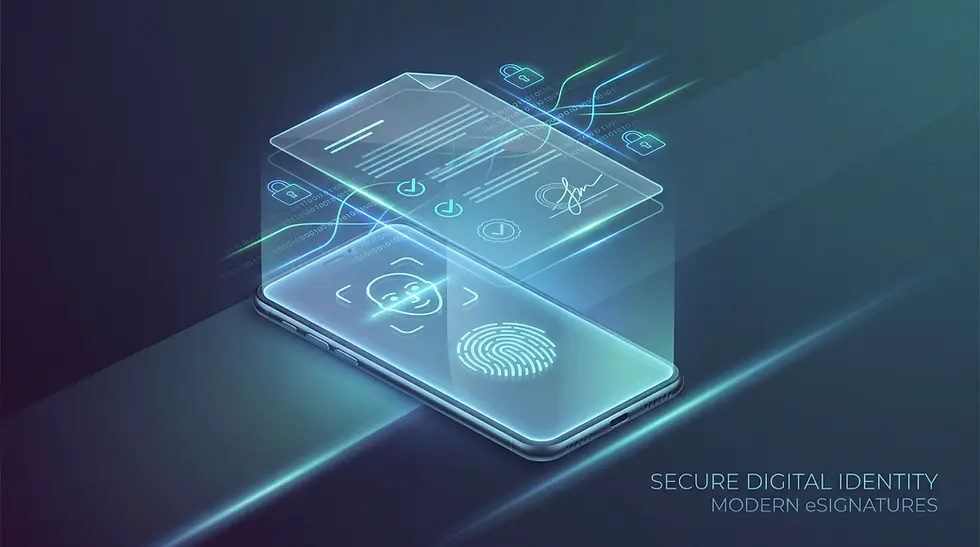
Identity verification has become a serious differentiator. Modern platforms can match a government issued ID against a live selfie, run knowledge based authentication questions, capture device telemetry, and bind the signing event to a verified identity rather than just an email link. For high stakes documents, regulated industries increasingly require this layer of assurance.
Blockchain, Smart Contracts, and What is Real
Blockchain technology has been promoted as the future of signing for more than a decade. In practice, very few mainstream eSignature workflows use a public blockchain today. The strongest use cases tend to involve specific niches like trade finance, intellectual property registries, and certain digital asset transfers. The underlying ideas, distributed ledgers and smart contracts, continue to influence how vendors think about audit trails, but they have not displaced traditional eSignature for everyday business documents.
eIDAS 2.0 and the European Digital Identity Wallet
In 2024, the European Union adopted the eIDAS 2.0 amendments. The most significant change is the European Digital Identity Wallet, a smartphone based wallet that every EU citizen, resident, and business will be able to use to identify themselves, sign documents, and share verified credentials across borders. Member states are required to make wallets available to citizens, with broad rollout expected between 2026 and 2027. For eSignature vendors, this is one of the most important regulatory shifts in a decade, because it standardizes a high assurance identity layer that any signing platform can plug into.
Key Milestones at a Glance
1976, Diffie and Hellman publish "New Directions in Cryptography"
1977, RSA algorithm published
1985, ElGamal signature scheme published
1991, NIST proposes the Digital Signature Standard
1994, DSA adopted as FIPS 186
1995, Utah Digital Signature Act becomes the first US state law on digital signatures
1996, UNCITRAL Model Law on Electronic Commerce published
1998, US and Ireland sign the first sovereign electronic agreement
1999, UETA released in the US, Directive 1999/93/EC adopted in the EU
2000, ESIGN Act signed by President Clinton on June 30
2003, DocuSign founded
2011, Adobe acquires EchoSign
2014, eIDAS Regulation adopted in the EU
2020, COVID-19 drives mass eSignature adoption
2022, Most US states have permanent RON laws
2024, eIDAS 2.0 adopted, European Digital Identity Wallet on the way
What the Future Holds
The next decade will be shaped by three forces. First, identity. As eIDAS 2.0 and similar frameworks deploy, signing will be tied to verified digital identities rather than email addresses. Second, AI. Drafting, review, negotiation, and post signature obligations will increasingly be handled by AI agents that work inside the eSignature platform. Third, embedded signing. Rather than visiting a vendor's website, more signing experiences will happen directly inside CRMs, HR platforms, banking apps, and proprietary SaaS products, powered by eSignature APIs.
For businesses, the practical lesson is simple. The platforms that win will combine strong cryptographic foundations, recognized global compliance, modern identity verification, deep integrations, and AI assistance that actually saves time. The history of electronic signatures shows a steady move from mathematical theory, to legal recognition, to mass adoption, and now to intelligent automation. The next chapter is being written right now.
Frequently Asked Questions
When were electronic signatures invented?
The mathematical foundation for modern electronic signatures was published in 1976, when Whitfield Diffie and Martin Hellman introduced public key cryptography. The first practical algorithm, RSA, followed in 1977. Legal recognition arrived in stages, with the US passing the ESIGN Act in 2000 and the EU adopting Directive 1999/93/EC in 1999.
Who invented the digital signature?
The concept of a digital signature was introduced by Whitfield Diffie and Martin Hellman in 1976. The first practical digital signature algorithm, RSA, was published in 1977 by Ron Rivest, Adi Shamir, and Leonard Adleman.
When was the ESIGN Act passed?
The Electronic Signatures in Global and National Commerce Act was signed into law by President Bill Clinton on June 30, 2000.
Are electronic signatures legally binding worldwide?
Yes, in most major jurisdictions. The US, the European Union, the United Kingdom, Canada, Australia, India, Japan, Brazil, and dozens of other countries have laws recognizing electronic signatures. The exact requirements vary, especially for high assurance use cases like notarization, qualified electronic signatures, or regulated industries. See what you need to know about eSignature laws for a deeper jurisdictional breakdown.
What is the difference between an electronic signature and a digital signature?
An electronic signature is a broad legal concept, any electronic sound, symbol, or process that shows intent to sign. A digital signature is a specific cryptographic technique used to implement electronic signatures with strong proof of identity and tamper evidence. The full breakdown is in eSignature vs digital signature, what is the difference.
What was the first court case involving an electronic signature?
Howley v. Whipple, decided by the New Hampshire Supreme Court in 1869, is widely cited as the earliest US case to recognize the enforceability of a signature transmitted electronically, in this case by telegraph. For the modern view, see are eSignatures court admissible.
How big is the electronic signature market today?
Industry estimates put the global digital signature market at about 3.92 billion US dollars in 2022, with projections of more than 43 billion US dollars by 2030, driven by remote work, regulatory acceptance, and AI assisted document workflows.
Closing Thoughts
Electronic signatures did not appear overnight. They are the product of fifty years of cryptography research, legal evolution, and software innovation. Understanding that history makes it easier to evaluate today's platforms and to plan for what comes next. If your business is still relying on paper or on a patchwork of legacy tools, the next step is to find an eSignature partner that has kept pace with this fifty year journey and is building for the next one. Our guide on how to choose the right eSignature tool for your business is a practical place to start.


Comments